Dua for Travelling: Safe Journey Prayers Every Muslim Should Know
Discover the authentic dua for travelling in Arabic and English with clear meaning, transliteration, and verified hadith references. Learn when to recite it, how to shorten prayers while travelling, and essential Islamic guidance for safe, blessed journeys by car, plane, or long distance.
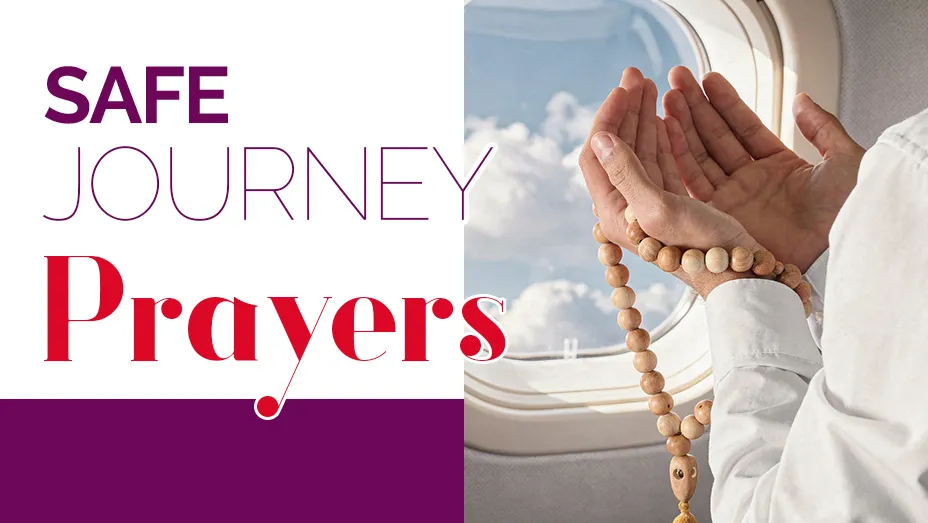
Travel looks simple from the outside. You pack a bag, lock your door, and head out. But in Islam, travel carries a deeper meaning that goes beyond sightseeing or catching flights. It becomes a reminder that life itself is a journey, and every step we take is part of something bigger.
For Muslims, travelling is not just about reaching a destination. It is about growth, reflection, and remembering Allah in moments of change. New places can shift our perspective. Long roads can humble us. Unexpected delays can test our patience. That is exactly why Islam gives guidance even for something as ordinary as travel.
The Prophet Muhammad (PBUH) treated travel with seriousness and awareness. He did not begin a journey casually. He started it with a dua.
What Is Dua and Why Does It Matter During Travel
Before going deeper, it helps to understand what a dua really is. Dua means calling upon Allah. It is asking for help, protection, guidance, or ease. There is no complicated formula. It is just sincerity.
Travel brings uncertainty. Flights get delayed. Roads feel long. Weather changes without warning. Even when everything seems perfectly planned, there is always something beyond our control. Dua acknowledges that reality. It reminds us that control ultimately belongs to Allah.
When someone recites a dua for travelling, they are not just repeating Arabic words. They are admitting dependence. They are saying, "We are stepping into the unknown, and we trust You." That trust changes the entire feeling of the journey. Fear softens. Anxiety lowers. The heart feels steadier.
This is why the dua for travelling is not optional in spirit. It becomes part of preparing the heart before preparing the suitcase.
The Main Dua for Travelling in Islam
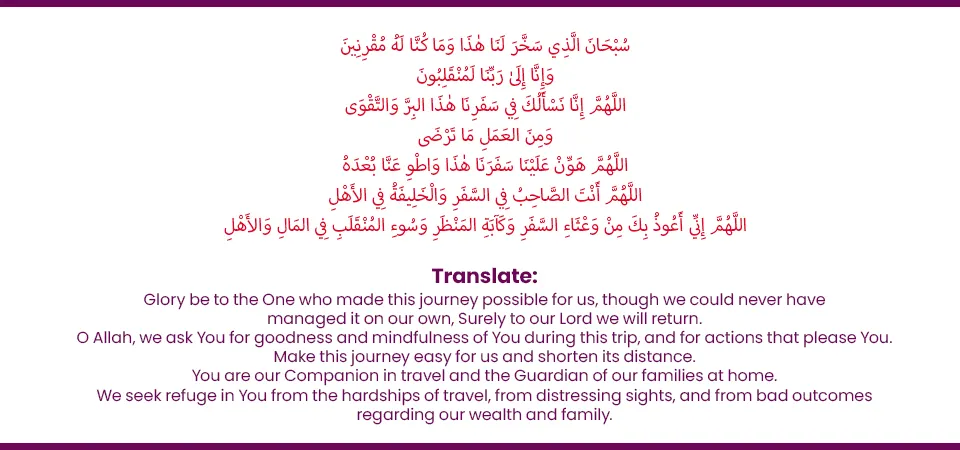
One of the most well-known travelling supplications was regularly recited by the Prophet (PBUH) at the beginning of a journey.
Dua for Travelling in Arabic
سُبْحَانَ الَّذِي سَخَّرَ لَنَا هٰذَا وَمَا كُنَّا لَهُ مُقْرِنِينَ
وَإِنَّا إِلَىٰ رَبِّنَا لَمُنْقَلِبُونَ
اللَّهُمَّ إِنَّا نَسْأَلُكَ فِي سَفَرِنَا هٰذَا البِرَّ وَالتَّقْوَى
وَمِنَ العَمَلِ مَا تَرْضَى
اللَّهُمَّ هَوِّنْ عَلَيْنَا سَفَرَنَا هٰذَا وَاطْوِ عَنَّا بُعْدَهُ
اللَّهُمَّ أَنْتَ الصَّاحِبُ فِي السَّفَرِ وَالْخَلِيفَةُ فِي الأَهْلِ
اللَّهُمَّ إِنِّي أَعُوذُ بِكَ مِنْ وَعْثَاءِ السَّفَرِ وَكَآبَةِ المَنْظَرِ وَسُوءِ المُنْقَلَبِ فِي المَالِ وَالأَهْلِ
Transliteration:
Subhan-alladhi sakhkhara lana hadha wa ma kunna lahu muqrineen, wa inna ila Rabbina la-munqaliboon.
Allahumma inna nas'aluka fi safarina hadhal-birra wat-taqwa, wa minal-‘amali ma tardha.
Allahumma hawwin ‘alaina safarana hadha, watwi ‘anna bu'dah.
Allahumma Antas-Sahibu fis-safari, wal-khalifatu fil-ahl.
Allahumma inni a'udhu bika min wa'tha'is-safari, wa ka'abatil-manzari, wa su'il-munqalabi fil-mali wal-ahl.
Dua for Travelling in English
Glory be to the One who made this journey possible for us, though we could never have managed it on our own.
Surely to our Lord we will return.
O Allah, we ask You for goodness and mindfulness of You during this trip, and for actions that please You.
Make this journey easy for us and shorten its distance.
You are our Companion in travel and the Guardian of our families at home.
We seek refuge in You from the hardships of travel, from distressing sights, and from bad outcomes regarding our wealth and family.
Understanding What This Dua Really Says
This dua is not random. Every line carries meaning.
It begins with "Allahu Akbar," which means Allah is the Greatest. Saying this three times centres the heart. It reminds the traveller that no problem on the road is bigger than Allah. Then it acknowledges something important. Travel is a blessing. Humans cannot fly naturally. We cannot cross oceans without tools. The dua admits that even having transport is a gift from Allah.
After that, the supplication shifts direction. It reminds us that one day we will return to our Lord. That line feels powerful because travel itself mirrors life. We leave one place and head toward another. Eventually, every soul returns to Allah.
The dua then asks for "birr" and "taqwa." Birr means goodness and righteousness. Taqwa means being aware of Allah and trying to avoid wrong actions. So this prayer is not only about physical safety. It is also about spiritual behaviour. It asks for the journey to be morally clean.
Finally, it asks for ease and protection. Ease in distance. Protection for family. Refuge from hardship. It even mentions protection from coming back to find harm in wealth or loved ones. Nothing is left out.
That is why this is the main dua for travelling in Islam. It is complete.
When Should You Recite the Dua for Travelling?
Timing adds depth to worship. The Prophet ﷺ would recite this supplication at the start of movement. That means right at the beginning of the journey.
You can say it:
- When leaving your home
- When sitting inside your vehicle
- At any point during a long trip
- When the car or plane begins moving
Travel is unpredictable by nature. That unpredictability is exactly why this dua feels grounding.
Dua for Leaving the House
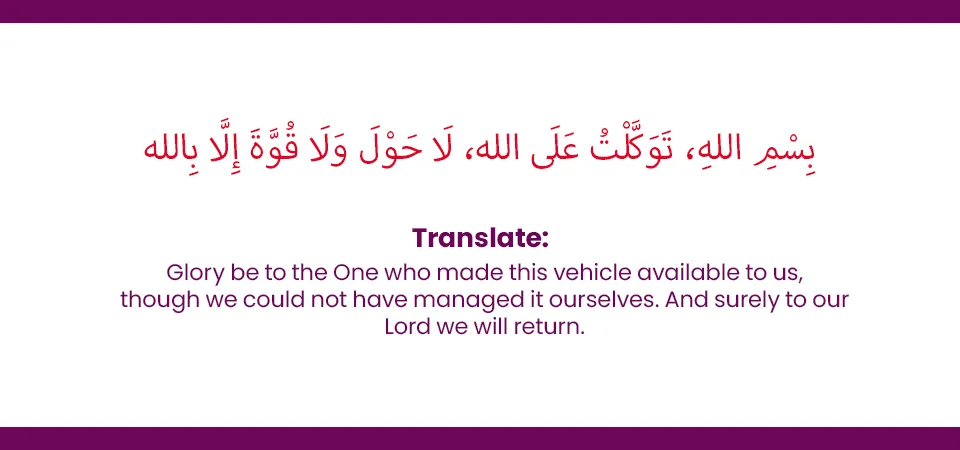
Before even reaching the car or airport, there is a shorter supplication that prepares the traveller spiritually.
بِسْمِ اللهِ، تَوَكَّلْتُ عَلَى الله، لَا حَوْلَ وَلَا قُوَّةَ إِلَّا بِالله
In English
In the name of Allah, we place our trust in Allah. There is no power and no strength except with Allah.
This short prayer is powerful because it introduces trust. Trust in Arabic is called "tawakkul." Tawakkul means depending on Allah while still taking practical steps.
A hadith states that when someone recites this dua as they leave home, they are told they are guided and protected. That reassurance carries weight.
Dua for Travelling in a Car
Driving can feel routine, but Islam teaches awareness even in routine moments. The same supplication about transport applies here.
سُبْحَانَ الَّذِي سَخَّرَ لَنَا هَذَا وَمَا كُنَّا لَهُ مُقْرِنِينَ وَإِنَّا إِلَىٰ رَبِّنَا لَمُنْقَلِبُونَ
In English
Glory be to the One who made this vehicle available to us, though we could not have managed it ourselves. And surely to our Lord we will return.
This dua for travelling in a car changes the mindset of the driver. Instead of feeling in control of everything, the heart recognises dependence. That awareness naturally makes a person calmer.
Dua for Travelling on a Plane
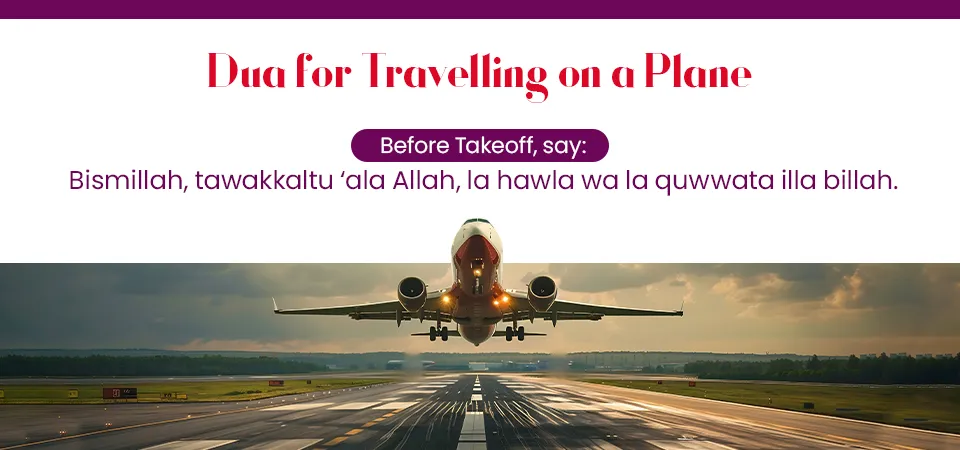
Flying can feel intense for many people. The height, the speed, and the lack of physical control can increase anxiety. That is where the dua for travelling on a plane becomes especially meaningful.
Before takeoff, say:
Bismillah, tawakkaltu ‘ala Allah, la hawla wa la quwwata illa billah.
During the flight, recite the main travel dua quietly. You can also repeat short phrases of remembrance, such as SubhanAllah, Alhamdulillah, and Allahu Akbar. These phrases are called dhikr, which means remembering Allah with the tongue and heart.
Dhikr stabilises emotions. It slows racing thoughts. It reminds the traveller that even thousands of feet above the ground, Allah's control remains perfect.
Entering a New City with the Right Intention
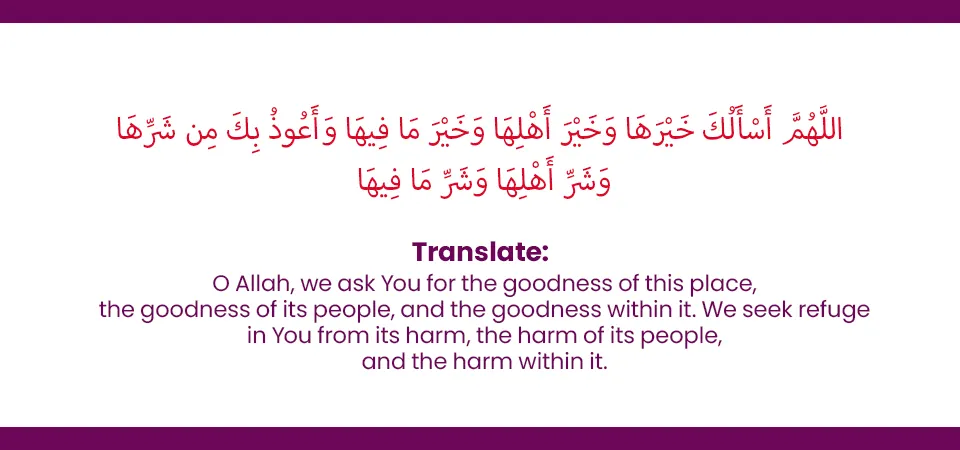
There is a beautiful dua recommended when entering a new town or city. It asks Allah for the goodness of that place and protection from its harm. This shows balance. We hope for good, but we also stay cautious.
اللَّهُمَّ أَسْأَلُكَ خَيْرَهَا وَخَيْرَ أَهْلِهَا وَخَيْرَ مَا فِيهَا وَأَعُوذُ بِكَ مِن شَرِّهَا وَشَرِّ أَهْلِهَا وَشَرِّ مَا فِيهَا
In English
O Allah, we ask You for the goodness of this place, the goodness of its people, and the goodness within it. We seek refuge in You from its harm, the harm of its people, and the harm within it.
This dua teaches emotional intelligence. It does not assume every place is perfect. It also does not assume every place is dangerous. That mindset helps a Muslim walk into new environments with both confidence and humility.
Dua for Travelling Long Distance
Long-distance travel carries different emotions. Short trips feel light. Long ones feel heavy. There is more planning. More waiting. More unknowns. That is why repeating the main dua for travelling a long distance becomes even more meaningful.
When the dua asks Allah to shorten the distance, it is not always about physical miles. Sometimes it is about emotional heaviness. Sometimes it is about making difficult moments feel lighter.
Long journeys test patience. The dua protects patience.
Dua for Returning from Travel
Returning home feels special. Familiar streets. Familiar rooms. And familiar faces. Islam teaches that coming back safely deserves gratitude.
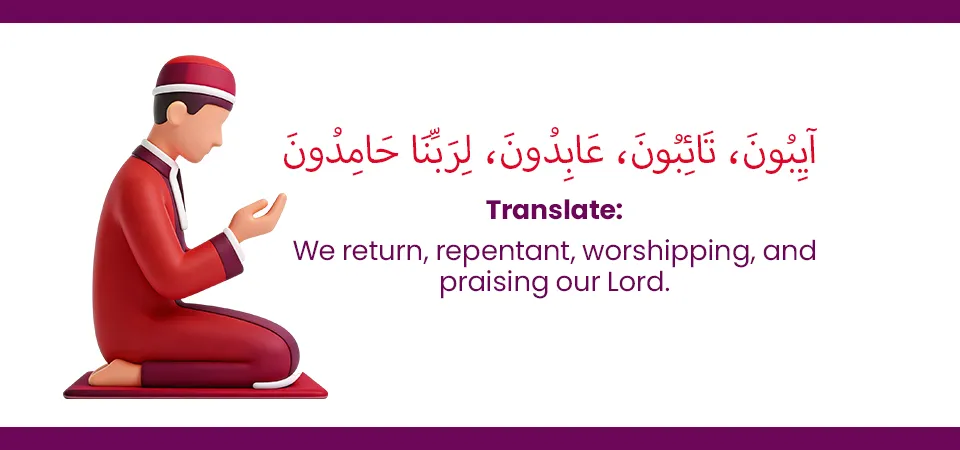
The Prophet (PBUH) would say a short but powerful supplication when returning.
آيِبُونَ، تَائِبُونَ، عَابِدُونَ، لِرَبِّنَا حَامِدُونَ
In English
We return, repentant, worshipping, and praising our Lord.
Gratitude matters here. Not everyone who leaves returns easily. Recognising that blessing builds humility.
Teaching Children Dua for Travelling
Children absorb habits early. Teaching them travel duas builds a strong foundation. It does not require long lectures. It requires repetition and warmth. Start with short phrases like "Bismillah" before leaving the house. Explain simply that it means beginning with Allah's name. When children understand the meaning, memorisation becomes easier.
Create small routines. Before the car starts, recite the dua together. On flights, whisper short dhikr quietly. Children copy what they see. Visual charts at home with Arabic, English translation, and transliteration can help.
When children grow up seeing dua connected to travel, they carry that habit naturally into adulthood.
Modern Travel Situations and Duas
Travel today looks different from how it did centuries ago. We have aeroplanes, high-speed trains, and online bookings. But the spiritual need remains unchanged. Whether someone is travelling for work, study, vacation, or pilgrimage, the same core dua for travelling applies. The context changes, but the reliance stays the same.
Students can make dua before leaving for exams in another city. Workers can make dua before business trips. Pilgrims can combine travel supplications with Hajj or Umrah-specific duas. Even short commutes can include remembrance. Spiritual habits adapt easily to modern life.
Islam's guidance feels timeless because it addresses the human condition, not just transportation methods.
Common Mistakes People Make When Saying Dua for Travelling
Even though the dua for travelling is simple, many people still miss the point of it. Not on purpose. Just out of habit. Travel gets busy. People rush. Bags need checking. Tickets need scanning. And the dua becomes something said quickly without feeling it.
That is where the problem starts.
Saying the Words Without Knowing What They Mean
This happens a lot. Someone memorises the dua in Arabic. They say it before the car moves. But if you ask them what it means, they are not sure. That makes the dua weak.
When the dua says Allah is the Greatest, that should calm the heart. When it asks for protection from hardship, that should feel real. Additionally, when it asks Allah to protect your family, that should touch something inside. If you do not understand Arabic fully, that is okay. Just read the dua for travelling in English once or twice. Understand the message. After that, even the Arabic words will feel alive.
Rushing the Dua Like It Is a Checklist
Another common mistake is speed. The car is ready. The engine is on. Someone quickly says the dua in five seconds. Done. Finished. Let's go. That is not how it should feel.
Even ten calm seconds make a difference.
Only Remembering Dua When Afraid
This one is very common. The plane starts shaking. Suddenly, everyone remembers Dua. Traffic looks dangerous. Now the dua starts. There is nothing wrong with calling Allah when scared. That is natural. But the dua for travelling is not only for emergencies. It is meant to be said before fear begins.
If you wait until panic hits, the heart is already racing. But when you begin the journey with remembrance, the heart stays softer from the start.
Forgetting to Thank Allah After Coming Back
People remember to ask for safety. But when they come home safely, they just move on. That is a missed moment. Returning home is a blessing. Being able to unlock your door again. Seeing your family again. Sleeping in your own bed again. That is not small. The dua for returning home is short. It says we return praising our Lord. That line matters.
Thinking Dua Means You Do Not Need Planning
This mistake is subtle but serious. Some people think saying a dua is enough, and planning does not matter. That is not correct. Islam teaches balance. Lock your door. Check your fuel. Confirm your flight time. Plan properly. Then make dua. Trust in Allah does not mean ignoring responsibility. It means doing your part and trusting Him with what you cannot control.
Expecting Something Dramatic to Happen
Sometimes people expect clear signs after making a dua. They expect a big, visible change. That is not how it works. Protection can look simple. Calmness can be the answer. A smooth journey can be the answer. Even a delay that saves you from harm can be the answer. Not every answered dua looks dramatic.
Final Thoughts
Travel will always have unknown parts. That is what makes it exciting. But it also makes it fragile. No one controls the road fully. No one controls the sky fully.
That is why the dua for travelling matters so much.
It shifts the mindset.
Instead of thinking, "I planned everything perfectly," the heart says, "Ya Allah, I depend on You."
The main dua for travelling in Arabic reminds us that transport itself is a gift. The dua for travelling in a car keeps daily drives mindful. Moreover, the dua for travelling on a plane calms fear above the clouds. The dua for travelling long distances builds patience for long roads.
When you begin your journey with remembrance, the trip feels different. Lighter. Calmer. More protected.
And when you return home safely and say thank you to Allah, something inside settles.
Travel becomes more than movement.
If your journey is taking you toward Umrah, let Emenac Travel handle the details so you can focus on worship. Explore our Umrah packages and begin your sacred journey with comfort and confidence.